
Treat Your Life Like an Experiment
 Have you ever spent so much time trying to figure out the right way to do something that you ended up doing nothing at all? (If you’re anything like me, the answer is 100% yes!)
Maybe you’re trying to decide when you should exercise. You read that mornings are best, but mornings are already chaotic. Maybe lunchtime would work better. Or after dinner. But will you actually do it then?
Maybe you want a better morning routine, a way to keep the kitchen from becoming a disaster every day, a system for remembering the things you always forget, or a bedtime that doesn’t somehow get later and later as the week goes on.
You start looking for the best solution. And suddenly something that could have been a small change becomes a surprisingly big decision.
I think we put a lot of pressure on ourselves to figure things out before we try them.
But lately I’ve been wondering: What if we didn’t have to know? What if we could just try something and see what happens?
We Treat Decisions Like They’re Permanent
I think one reason change can feel so difficult is that we often approach it as though we’re making a permanent decision.
From now on, I’m going to exercise in the morning. I’m going to meal plan every Friday. I’m going to keep the kitchen clean every night. This is where we’re keeping the keys from now on.
Even the words from now on make the whole thing feel heavier. Because now we’re not simply trying something Tuesday morning. We’re apparently making a commitment to Every Tuesday Morning for the Rest of Our Lives.
No wonder we want to be sure we’re choosing correctly.
But most everyday decisions don’t actually require that kind of certainty. You can put the keys there for a week. You can try exercising in the morning three times. You can test the new evening routine. You can move the basket. And then you can see what happens.
What If You Called It an Experiment?
There’s something I like about the word experiment. I saw another online business owner use it this way. She’d been having trouble getting herself to publish things online, but then decided to stop thinking of them as permanent decisions and start treating them as “experiments” instead. Now she’s publishing things left and right!
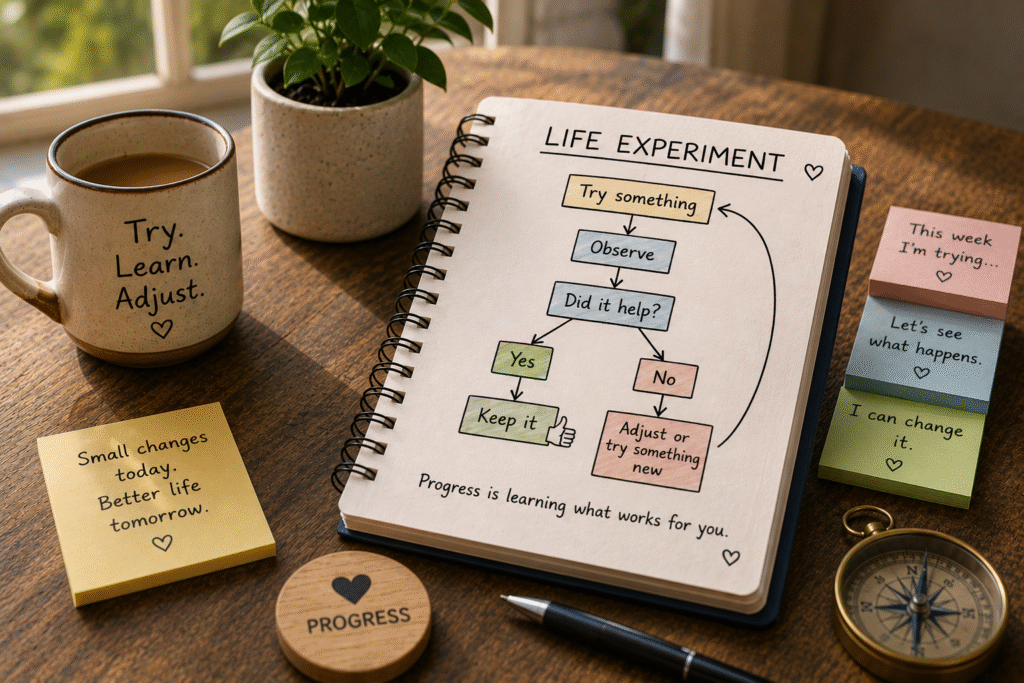
An experiment isn’t supposed to begin with certainty. You have an idea. You try it. You observe what happens. Then you use what you learned to decide what to do next.
That’s very different from: I made a plan. I didn’t follow it perfectly. Therefore, I failed.
If I’m running an experiment and something doesn’t work, that’s information. Maybe I thought I’d exercise right before bed because that’s when I have the most free time, and discovered that I’m miserable doing it then. Okay. Now I know something I didn’t know before.
Maybe I put a basket near the hallway because I thought I’d remember to bring it into the bedroom whenever I walked past it. Instead, the basket became part of the scenery and I stopped seeing it.
Interesting. That’s useful information too.
The experiment didn’t fail.
It gave me data.
You Don’t Have to Find the Perfect Solution
This is especially useful if you’re someone who likes to think things through.
Thinking things through can be incredibly helpful. It can also become a way of trying to eliminate every possible problem before we begin.
We want to choose the best exercise schedule. The best planner. The best organization system. The best way to save money. The best morning routine. But sometimes there isn’t one best answer.
There’s simply an answer that works better for you, in this particular season of your life, under your particular circumstances.
And there’s only so much you can learn about that by thinking. Eventually, you have to see what happens on a real Tuesday.
Start With a Reasonable Guess
Treating life like an experiment doesn’t mean making random changes constantly.
You don’t need to move everything in your kitchen every three days just to keep things interesting.
Start with what you already know. If you’re exhausted at night, don’t build a new habit that requires enormous amounts of evening energy.
If you always walk through the same door when you leave the house, that’s probably useful information when you’re deciding where to put something you need to remember.
If you know you won’t spend an hour meal planning every week, don’t build a system that requires you to do exactly that.
Use what you already know about yourself and your life to make a reasonable guess.
Then test it.
The goal isn’t to predict perfectly what will work. It’s to give yourself a good place to start.
Make the Experiment Small
This part matters.
If you’re going to experiment, don’t change twelve things at once.
If you completely redesign your morning, change your diet, start exercising, reorganize the kitchen, and create a new budgeting system in the same week, you won’t have any idea which changes helped and which ones made everything harder.
Instead, choose something small enough that you can actually observe it. Try leaving your walking shoes by the door for a week. Put your reusable grocery bags somewhere different and see whether you remember them more often. Move your phone charger to the place where you always wish you had it. Try planning three dinners instead of seven.
The smaller the experiment, the easier it is to answer:
Did this make things better?
Decide What You’re Testing
It also helps to know what you’re hoping will change.
Not in a complicated, spreadsheet-and-clipboard kind of way.
Just ask yourself: What am I hoping this makes easier?
If you’re moving your keys, maybe you’re testing whether you spend less time looking for them. If you’re putting your water bottle on your desk, maybe you’re testing whether you drink more without having to remind yourself. If you’re moving a task to the morning, maybe you’re testing whether it happens more consistently when you have more energy.
You don’t necessarily need numbers. You’re simply paying attention.
- Did this help?
- Did I actually use it?
- Was it easier?
- Did it create a new problem I hadn’t expected?
Those answers tell you what to do next.
Give It Long Enough to Learn Something
Some experiments give you an answer almost immediately.
If you move something to a more convenient place and instantly use it more often, that’s pretty easy to notice.
Other changes need a little time.
A new morning routine may feel strange simply because it’s new. A different organization system may take a week or two before you know whether you’re actually going to maintain it.
The point isn’t to abandon every idea the first time it’s inconvenient. It’s also not to keep forcing something for six months because you once decided it should work.
Give the experiment enough time to teach you something. Then pay attention to what it’s teaching you.
Keep What Works. Change What Doesn’t.
This may be my favorite part.
At the end of an experiment, you don’t have only two choices: success or failure.
You have several.
- Maybe it worked beautifully. Keep it.
- Maybe part of it worked. Keep that part and change the rest.
- Maybe it worked, but it required too much effort. Can you make it easier?
- Maybe it didn’t work at all. Try something different.
- Maybe your circumstances changed halfway through and you learned absolutely nothing useful about the original idea.
That’s okay too. You aren’t signing a contract with your first solution. You’re learning.
Something Can Work Now and Stop Working Later
There’s another reason I like thinking this way: even a successful solution doesn’t have to become permanent.
Something may work wonderfully for you now and stop working six months from now.
Your schedule changes. Your kids get older. Your work changes. Your energy changes. You move.
Something that once made life easier starts creating friction instead. That doesn’t mean you chose incorrectly the first time. It means the conditions changed.
A solution doesn’t have to work forever to have been the right solution for a while.
You get to run another experiment.
I think we sometimes keep doing things long after they’ve stopped helping simply because this is the way I do it.
But you’re allowed to ask: Is this still working?
And if the answer is no, you can change it.
Experiments Take Some of the Judgment Away
I think this may be the biggest reason I like this idea.
When every change is a test of whether we’re disciplined, organized, motivated, or capable enough, there’s a lot riding on every attempt.
When something doesn’t work, we make it mean something about ourselves.
But if I’m experimenting, I can be curious instead. Huh. I thought that would help, but it didn’t. Why?
- Maybe the timing was wrong.
- Maybe there was more friction than I realized.
- Maybe I forgot about it.
- Maybe it asked too much of me on an ordinary day.
- Maybe there’s another version worth trying.
Curiosity gives us somewhere to go next. Judgment usually doesn’t.
I’m Still Experimenting Too
I don’t want this to sound as though I’ve figured out the perfect way to design my life.
Believe me, I haven’t.
I’m constantly noticing things that aren’t working quite as well as I’d like, trying small changes, keeping some, abandoning others, and occasionally wondering why something that sounded so sensible was a complete disaster in real life.
And there are still times when I completely freeze and do absolutely nothing because I want to be 100% sure before I make a change.
But I don’t think we’re ever really done. Our lives keep changing, which means the things that work for us will sometimes need to change too.
The goal isn’t to eventually arrive at a perfectly designed life where nothing ever needs adjusting. It’s to get better at noticing what isn’t working and feel comfortable trying something else.
Try One Little Experiment
Think of one small thing in your life that isn’t working quite the way you’d like.
- Not your entire morning.
- Not your entire house.
- Not your entire health routine.
One thing.
Now ask yourself: What’s one reasonable change I could test?
Choose how long you want to try it. Maybe that’s three days. Maybe it’s a week. Maybe you need two weeks to really know.
Then pay attention.
- What got easier?
- What stayed difficult?
- What surprised you?
- What would you change next time?
You don’t need to decide whether this is how you’re going to do things forever. You’re just running an experiment. And when it’s over, you’ll know something you didn’t know before.
You don’t have to get it right. You just have to learn what works.
Ready to Redesign Something in Your Real Life?
If you like the idea of treating changes as experiments instead of permanent decisions, that’s a big part of how I approach life design.
I created Designed for Real Life to help you take something that isn’t working and redesign it around the life you actually have… not the perfect life you think you’re supposed to have.
You’ll choose one thing to improve, look at what’s making it harder than it needs to be, design a more realistic solution, and then test it in your actual life.
Because you don’t need to find the perfect solution.
You just need to find something that works better for you.
