
Design Around Your Real Life (Not the Life You Wish You Had)
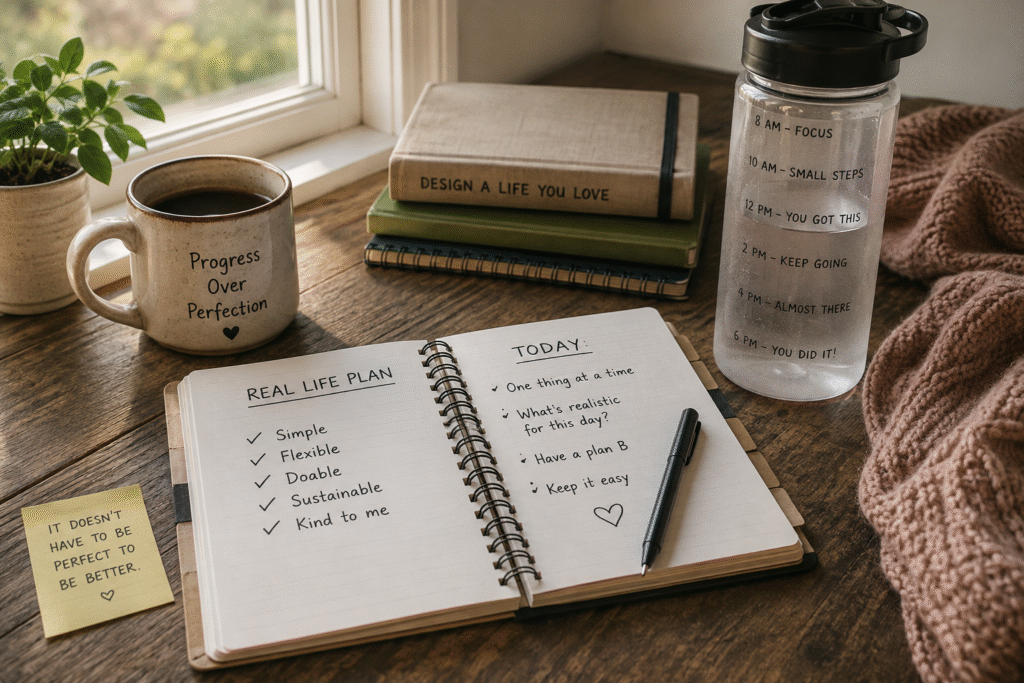 Have you ever created a plan that looked absolutely perfect…until you actually tried to live it?
Maybe you decided you’d wake up an hour earlier every morning to exercise. (I’ve tried that.) You’d meal prep every Sunday. (I’ve wanted to do that too.) You’d keep the house picked up, spend less time on your phone, drink plenty of water, go to bed on time, and finally stay on top of all those little things you never seem to get around to.
On paper, it worked beautifully.
There was just one problem.
The person the plan was designed for didn’t really exist.
She always had enough energy. Nothing unexpected interrupted her day. She never slept badly, ran late, got sick, had someone else need her, or simply reached the end of a long day and thought, I just can’t do it tonight.
Real life, unfortunately, didn’t get a copy of the plan.
We Make Plans for Our Best Days
I think most of us do this without realizing it.
When we’re trying to change something, we tend to plan around the version of ourselves who is rested, motivated, organized, and completely in control of the day. We think about what we could do under good circumstances and build our expectations around that.
Maybe it even works for the first day or two! But then the next day happens.
You wake up tired. Something takes longer than expected. Someone needs you. You’re hungry and there’s nothing easy for dinner. Your beautifully planned workout is supposed to take 45 minutes, but you have 17.
Suddenly the system that seemed completely reasonable doesn’t work at all. And too often, we decide that means we failed.
And of course, if we failed…it must have been our fault. Maybe we weren’t disciplined enough. Maybe we needed to try harder. Or maybe we’re just terrible at sticking with things.
But what if the problem isn’t you? What if the plan simply wasn’t designed for the way your real life is?
Your Real Life Is Not an Inconvenience
This is something I’ve been thinking about a lot.
We often treat the realities of our lives as obstacles that are getting in the way of the way we’re supposed to live.
If only work weren’t so busy, I’d exercise. If only the kids didn’t need so much in the morning, I’d have a peaceful morning routine. If only I had more energy at night, I’d finally get the house organized. If only my schedule were more predictable, I’d cook every night.
Of course, circumstances can change. Sometimes life really does open up and give us more time, energy, or flexibility.
But I don’t think we should have to wait for that imaginary future before we’re allowed to make things better.
Your real life isn’t the thing your system has to overcome. It’s the thing your system needs to be designed around.
That’s a very different way of looking at it.
Stop Designing for the Ideal Version of You
There are countless versions of the “ideal you.” The ideal you wakes up when the alarm goes off. She remembers everything. She always has groceries. She never gets tired at 3:00 in the afternoon and wishes she could take a nap.
She has enough patience to follow complicated systems and enough motivation to do things even when they’re inconvenient. She’s impressive.
She’s also exhausting to design a life around.
Because every time the real version of you behaves like an actual human being, the system starts falling apart.
I’d rather design for her.
The person who sometimes gets tired. The person who forgets things. The person whose schedule gets disrupted. The person who has good intentions but doesn’t necessarily want to take seven extra steps to follow through on them.
That’s not lowering the bar. It’s making the bar reachable.
Ask What Happens on a Real Day
One question I find incredibly useful when I’m trying to make something work is:
What does this look like on a real day?
Not my most productive day. Not the day when I slept eight uninterrupted hours and woke up feeling fantastic, and not even the imaginary Monday when I’m suddenly going to become a completely different person.
A normal Tuesday.
What time do I actually get up? When do I actually have energy? Where am I already going to be? What tends to interrupt me? What am I realistically willing to do? Those details matter.
Because a system that ignores them may look wonderful on paper and still be almost impossible to maintain.
Make the Good Version Easy…and Create a Real-Life Version Too
I don’t think designing for reality means we shouldn’t have goals or challenge ourselves. It means we stop making the ideal version the only version that counts.
Maybe your ideal workout is 45 minutes. Great, but what’s the version for the day when you only have 10? You might want to cook a healthy dinner from scratch every evening. But what’s dinner on the night when you’re exhausted and everyone is hungry now? Maybe your ideal evening routine includes cleaning the kitchen, preparing for tomorrow, reading for 20 minutes, and getting to bed by 10:30. But what’s the version you can still do when it’s already 10:20 and you’re completely exhausted?
I think we need both.
We can have a version for the days when things go according to plan, and a version that keeps us moving forward when they don’t. The second one isn’t the failure version.
It’s part of the design.
Sometimes the Best System Is Almost Ridiculously Easy
I’ve become increasingly interested in solutions that don’t require me to be particularly impressive. A perfect example happened while I was filling my water bottle.
My 24-ounce bottle takes about a minute to fill. I refill it several times a day, and because filling it requires both hands, I used to stand there waiting and thinking about how I couldn’t really do anything else until it was finished.
Recently, I started doing 10 calf raises while I wait. That’s it. I’m not changing into workout clothes. I’m not finding another 20 minutes in my schedule. I’m not adding “calf raises” to a habit tracker.
I’m already standing there. The minute already exists. I just attached something useful to it. Is doing 10 calf raises while filling a water bottle going to transform my health? Of course not. But that’s almost beside the point.
It works because it’s designed around something that is already true about my life. I already fill the bottle. I already stand there for about a minute. I already do it several times a day. The system doesn’t require my life to change before I can use it. And if I can do something like that multiple times a day, it adds up.
Look for What Is Already True
This is one of my favorite places to start when designing something new.
Instead of asking only: What should I be doing?
also ask: What is already true about my day that I can design around?
Maybe you’re already in the kitchen every morning while you’re making coffee. Maybe you’re already sitting in the school pickup line. Maybe you always have more energy at 10:00 a.m. than at 8:00 p.m. Maybe you walk past the same cluttered counter twenty times a day. Maybe you always forget something when you’re rushing out the door.
Those aren’t insignificant details. They’re clues.
Your existing routines, energy patterns, environments, annoyances, and constraints give you information about what might actually work.
Make It Easier to Succeed on Your Worst Reasonable Day
There’s another question I think is worth asking:
Will this still work when the day isn’t going particularly well?
I don’t mean designing your entire life around emergencies or the absolute worst day imaginable. I mean the ordinary bad days. (Or, you know, what you might call a regular day!)
You slept poorly. Work was frustrating. You’re running behind. Your energy is low. Something unexpected came up.
If your system completely collapses under those fairly normal conditions, it may be too fragile.
That’s where having a smaller version can help. Ten minutes of movement instead of 45. A frozen meal you intentionally keep available instead of ordering takeout because the original dinner plan fell apart. Putting tomorrow’s clothes out and calling that enough instead of completing an elaborate nighttime routine. A five-minute reset instead of cleaning the whole room.
You haven’t failed at the “real” version. This is the real version.
Good Systems Have Failsafes
I like thinking of these smaller versions as failsafes.
A failsafe doesn’t guarantee you’ll do everything perfectly. It simply keeps one difficult day from turning into “Well, I guess I’m not doing this anymore.”
If you know ahead of time what you’ll do when time is short, energy is low, or something goes wrong, you don’t have to make that decision when you’re already depleted.
You’ve designed for it.
And there’s something surprisingly calming about knowing that your plan doesn’t require every day to cooperate.
Here’s something I do. Every Friday I tell myself I’m going to meal plan so I know exactly what we’re having for dinner every night the following week.
It almost never happens.
So instead, I make sure that I have at least three meals planned. I don’t even decide what nights we’ll eat them. I just know I’m going to make those three meals, and when I go grocery shopping, I make sure I have everything I need for them.
On nights when I have more time and energy, I can decide what else sounds good. But my entire dinner plan no longer depends on me having the time and energy to plan all of my meals perfectly.
Three planned meals may not be my ideal system, but it’s a system that helps me on the nights I need it most.
You Are Allowed to Change the System
There’s one more part of designing around real life that I think we forget. The system isn’t in charge. You are.
If something worked beautifully six months ago and doesn’t work now, you don’t have to keep forcing yourself to follow it just because it used to work.
Schedules change. Families change. Jobs change. Bodies change. Priorities change. Energy changes. A system can be perfectly good and still stop fitting your life.
That doesn’t mean you failed. It means you have new information. Use it.
Design for the Person Who Is Actually Going to Live It
I don’t think the goal is to create a perfectly optimized life. I don’t think that’s possible, and I’m not sure I’d want it anyway.
There will always be interruptions. There will always be things we didn’t plan for. And there will always be parts of our lives we could make a little better.
The goal is simply to stop creating plans that require us to become different people before they can work.
So the next time you’re trying to build a habit, change a routine, solve an everyday frustration, or make something in your life work better, ask yourself:
What would change if I designed this for reality instead of perfection?
Design around your actual schedule. Your actual energy. Your actual environment. Your actual responsibilities. Your actual Tuesday.
Because the best system isn’t the one that looks perfect on paper.
It’s the one that works in the life you’re actually living.
Try This: Design One Thing for a Real Day
Choose one habit, routine, or part of your life that isn’t working as well as you’d like.
Then ask yourself: What am I currently expecting myself to do?
Now compare that expectation with what actually happens on a normal day.
Where’s the mismatch?
Maybe you’re expecting yourself to do something at a time when you’re usually exhausted. Maybe the task takes longer than the time you realistically have. Maybe you’re relying on yourself to remember something you regularly forget. Maybe your plan only works when nothing unexpected happens.
Don’t redesign everything. Just change one part of the system so it fits your real life a little better. Then try it.
You don’t need to create the perfect solution today. You just need one that’s a little more likely to work tomorrow.
Want Help Designing Something That Actually Works for You?
If you just identified something in your life that isn’t working as well as you’d like, you don’t have to figure out the redesign completely on your own.
Designed for Real Life walks you through choosing one thing you want to improve, figuring out what’s actually getting in the way, and creating a realistic solution around your real schedule, energy, environment, and responsibilities.
Because you don’t need another perfect plan that’s going to work beautifully for three days and then fall apart.
You need something designed for your life.
If you’re ready to take the one thing you identified above and make it work better in the life you’re actually living, Designed for Real Life can help you do exactly that.
