
Stop Trying to Fix Everything: Start With the One Change That Matters Most
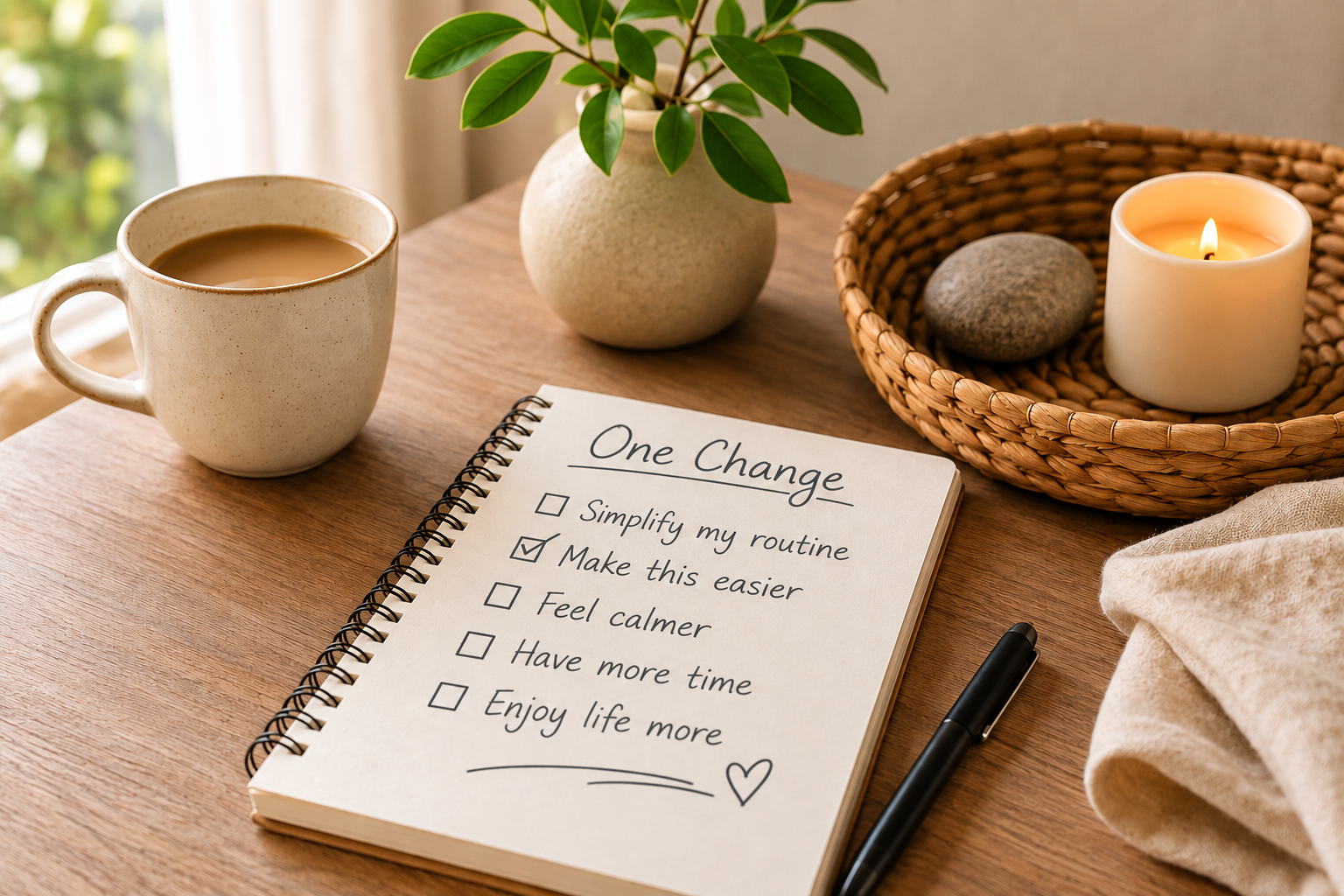 Have you ever decided you were finally going to get your life together?
Maybe you wanted to exercise more, eat healthier, get your house organized, spend less money, go to bed earlier, stop wasting so much time on your phone, drink more water, stay on top of laundry, and somehow find more time for the people you love.
So you made a plan.
And suddenly, instead of feeling excited about making your life better, you felt exhausted before you’d even started.
I’ve done this more times than I’d like to admit.
There’s something incredibly tempting about the idea of fixing everything at once. If several parts of life aren’t working particularly well, why not tackle all of them? Why settle for improving one thing when you could create an entirely new life starting Monday morning?
The problem is that Monday morning eventually arrives.
And we’re still the same people, with the same number of hours in the day, living the same complicated lives we were living on Sunday.
Maybe the answer isn’t to make a better plan for fixing everything.
Maybe it’s to stop trying to fix everything in the first place.
When Everything Feels Important, Nothing Feels Clear
One of the hardest things about wanting to improve your life isn’t necessarily figuring out what could be better.
Usually, that’s the easy part.
Give me five minutes and I can come up with a pretty impressive list of things I could improve. There are things around my house I want to organize, healthy habits I want to be more consistent with, projects I’ve been meaning to finish, things I want to do with my family, financial goals I’d like to work toward, and plenty of little annoyances I’d love to make easier.
The problem isn’t finding something to work on.
It’s deciding which thing deserves my attention first.
When everything feels equally important, our natural instinct is often to try to work on all of it. We make a giant list, create an ambitious new routine, and tell ourselves that this time we’re really going to stick with it.
For a few days, maybe we do.
Then real life happens.
Someone gets sick. Work gets busy. We sleep badly. An appointment takes longer than expected. The dishwasher breaks. Or maybe nothing dramatic happens at all…we simply discover that maintaining twelve new habits at the same time takes a lot more energy than we thought it would.
Before long, we’re back where we started, except now we’re also frustrated with ourselves because we couldn’t keep up with the plan.
More Improvements Can Create More Pressure
This is one of the strange things about self-improvement.
Something that is supposed to make our lives better can accidentally make them feel worse.
Exercise is good for us. Saving money is good for us. Getting enough sleep is good for us. Keeping our homes reasonably organized is helpful. Spending meaningful time with people we care about matters.
None of those goals is the problem.
The problem comes when every good idea turns into something else we’re supposed to be doing.
Suddenly, we’re not just living our lives. We’re carrying around a mental list of all the ways we’re currently failing to live them correctly.
I don’t think we need another list.
I think we need a better way to decide what matters right now.
Ask a Different Question
Instead of asking:
What should I fix?
I’ve been trying to ask:
Which one change would make the biggest difference?
Those questions sound similar, but they lead somewhere completely different.
“What should I fix?” can produce twenty answers.
“Which one change would make the biggest difference?” forces you to look for leverage.
You’re not asking which problem is the most annoying, which goal sounds the most impressive, or which habit everyone on the internet says you should have.
You’re looking for the change that could make other things easier too.
And sometimes, it’s not the thing you expect.
Look for the Domino
Imagine lining up a row of dominoes.
You could walk along and knock each one over individually. It would work, but it would take a lot of unnecessary effort.
Or you could find the first domino, give it one small push, and let that movement affect everything that comes after it.
Life obviously isn’t quite that neat. Fixing one thing won’t magically solve every other problem.
But some changes really do have a larger effect than others.
Going to bed 30 minutes earlier might give you more energy in the morning, which makes exercising easier, which improves your mood, which makes you more patient with your family.
Creating one place near the door for your keys, wallet, and other things you need might eliminate the frantic search every morning, help you leave the house on time, and make the beginning of your day feel calmer.
Planning three easy dinners before the week begins might reduce last-minute takeout, save money, eliminate several decisions, and make evenings less stressful.
The change itself may be small.
Its effect doesn’t have to be.
Some Examples From My Own Life
Here are a couple of small changes I’ve made in my own life that ended up helping much more than I expected. I didn’t make all of these changes at once. I made one small change, let it become part of my normal routine, and eventually noticed something else I could improve.
My weekday mornings used to feel hectic. From the minute I woke up until my daughter was on her way to school or camp, I was running around trying to make sure both of us were ready for the day. I was also worried I’d forget something she needed.
So, with her help, I started having her choose her clothes the night before.
It sounds almost ridiculously small. But choosing clothes in the morning took a few valuable minutes at exactly the time when minutes felt scarce. Now, right before bedtime, we choose what she’ll wear the next day. It only takes a few minutes, but it makes the morning less stressful and gives me a little more time to make sure she has everything she needs.
Another change happened almost by accident, but it has made an even bigger difference in my life.
I used to work in the living room, sitting on my couch. Eventually, sitting in that position all day started bothering me, so I decided to put a desk and chair in my bedroom and create a better place to work.
Guess what else is in my bedroom?
My treadmill.
Suddenly, instead of being several rooms away from it while I worked, I was sitting about 12 feet away.
That tiny difference changed my behavior almost immediately. I started using the treadmill much more often because there was almost nothing standing between thinking about walking and actually doing it. I could stand up from my desk, walk a few steps with my laptop, and work while I walked.
Now I regularly spend at least an hour of my workday walking on the treadmill.
I didn’t suddenly become more motivated. I didn’t create an elaborate new exercise routine. I accidentally changed my environment in a way that made something I already wanted to do much easier.
It doesn’t have to be a big change to make a big difference in your life.
You won’t always know in advance which small change will have the biggest impact. Sometimes you make an adjustment for one reason and discover that it improves something completely different. That’s why I think of these changes as experiments rather than permanent solutions. Try something small, pay attention to what happens, and keep what helps.
The Biggest Difference Doesn’t Always Come From the Biggest Change
I think this is where we sometimes get stuck. If we want a meaningful result, we assume we need to make a meaningful-looking change.
We decide we need an entirely new morning routine. A complete home organization system. A strict budget. A complicated workout schedule.
But the size of the solution doesn’t always have to match the size of the frustration.
Sometimes one surprisingly small adjustment removes a problem you encounter over and over again.
That’s why I’m much more interested in finding high-impact little changes than creating impressive plans.
A five-minute change that makes something easier every single day can eventually matter more than a huge change you maintain for four days.
You Can Keep the Rest of the List
There’s another reason I like choosing one thing. It doesn’t mean the other things don’t matter.
You’re not saying, “I’m never going to organize that closet.” You’re not giving up on eating healthier, saving more money, exercising regularly, or finally dealing with the giant pile of papers on the kitchen counter.
You’re simply saying: Not yet.
I think there’s something incredibly freeing about that.
You can keep the list. You can add things to it when you notice them. You can even be excited about what you might change eventually. But you don’t have to actively improve all of them today.
You only need to decide what deserves your attention now.
Your One Thing Can Change
And just like I talked about last week, none of this is permanent.
The thing that would make the biggest difference in your life today may not be the thing that matters most six months from now.
Life changes.
Our families change. Our schedules change. Our priorities change. Our energy changes.
That’s why I don’t think there’s one perfect system we eventually discover and then use forever.
We’re constantly adjusting.
Sometimes we’ll make a change that works beautifully. Sometimes we’ll try something and realize it didn’t help nearly as much as we expected. Sometimes something that worked for years will suddenly stop fitting our lives.
That’s okay.
The goal isn’t to finally get your entire life “fixed.”
The goal is to get a little better at noticing what would help now.
What Would Make Everything Else a Little Easier?
If your brain is currently supplying you with a list of twelve things you should improve, don’t start working through the list.
Look at it differently. Ask yourself: Which one change would make the biggest difference?
You can also try asking: If I made this easier, would anything else become easier too? That’s often where the interesting answers are.
Maybe the laundry isn’t actually the problem. Maybe evenings are chaotic because you’re exhausted.
Maybe spending isn’t the first thing to tackle. Maybe you’re ordering expensive takeout because deciding what to make for dinner at 6:00 p.m. is miserable.
Maybe you don’t need a better exercise plan. Maybe, like me, you need to make exercise easier to start.
Look for the thing underneath the thing.
Look for the domino.
You Don’t Have to Fix Your Whole Life
There’s always going to be something we could improve. I actually think that’s good news.
It means we’re never finished experimenting, learning, adjusting, and finding little ways to make our lives work better.
But we don’t have to do all of those things at once.
You don’t need to wake up tomorrow as a more organized, productive, healthy, financially responsible, well-rested version of yourself.
You just need somewhere to begin.
So if life feels like it has a dozen things that need your attention right now, don’t ask yourself how you’re going to fix all of them.
Ask: Which one change would make the biggest difference?
Then start there.
Try This: Find Your One Change
Take five minutes and write down the things in your life that currently feel harder, messier, or more frustrating than you’d like.
Don’t solve them yet. Just get them out of your head.
Then look at your list and ask:
Which one change would make the biggest difference?
If you’re not sure, look for something that happens frequently, drains a disproportionate amount of your energy, or would make another problem easier if you improved it.
Choose one.
The rest of the list can wait.
For now, see what happens when you give one meaningful change your full attention.
Ready to Make That One Thing Easier?
Sometimes identifying what you want to change is the easy part. Figuring out why it isn’t working now…and what would actually work better in your real life…is harder.
That’s exactly what Designed for Real Life is designed to help you do.
Instead of trying to overhaul your entire life, you’ll choose one thing that’s making life harder than it needs to be, figure out what’s getting in the way, and design a realistic improvement around the life you actually have.
You’ll look at things like your real schedule, your energy, your environment, and the little points of friction that can make even good intentions difficult to follow through on.
Because the goal isn’t to create the perfect system.
It’s to create something that works for you, in your real life.
If you’ve figured out the one thing you’d like to make easier, Designed for Real Life can help you take the next step.
