
Why Does Life Feel Harder than it Needs to Be?
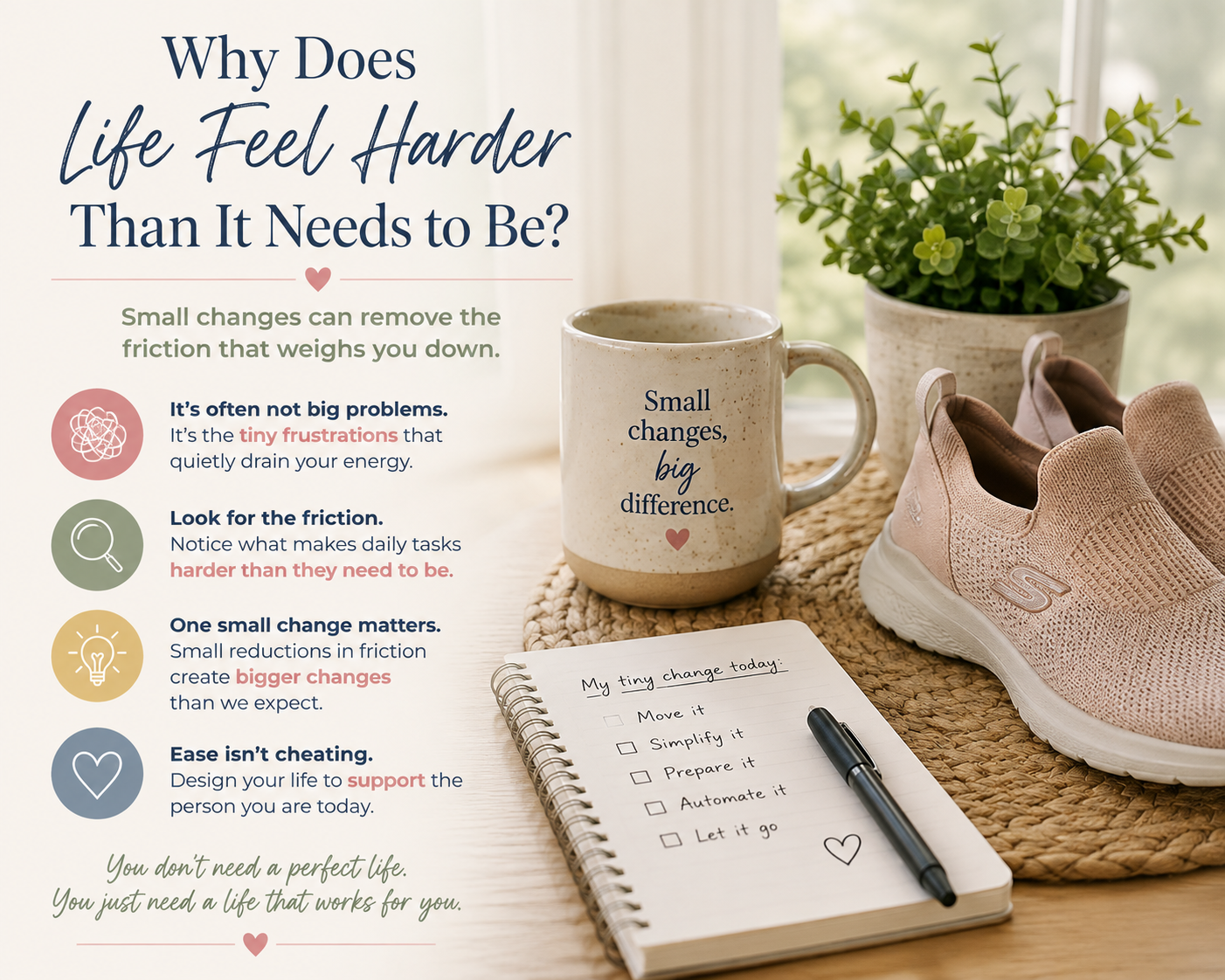 There are seasons of life when things are genuinely difficult. Illness, financial struggles, losing someone you love, raising young children, or caring for aging parents all bring challenges that no amount of organizing or positive thinking can erase. Those situations are real, and it’s important to acknowledge that.
But there are also plenty of ordinary days that somehow feel much harder than they should. You misplace your keys again. Dinner becomes another stressful decision. The kitchen is somehow messy before lunch. You keep meaning to exercise, but by the end of the day you’re exhausted. You know what you want to do, yet somehow it never quite happens.
If you’ve ever gone to bed wondering, Why does everything feel so difficult? you’re certainly not alone.
For a long time, I assumed the answer was simple. I thought I needed more motivation, more discipline, better habits, or a stronger morning routine. Like many people, I believed the solution was to try harder.
Eventually, though, I realized something surprising. Many of the things making life difficult weren’t actually big problems. They were dozens of tiny ones. Individually, they barely mattered. Collectively, they were exhausting. And tiny problems have a way of piling up until life feels much heavier than it really needs to.
Maybe the Problem Isn’t You
When something feels difficult over and over again, it’s easy to believe something must be wrong with you. Maybe you’re lazy. Maybe you’re disorganized. Maybe everyone else has figured out something you haven’t.
But what if that’s not the real problem? What if your life isn’t hard because you’re failing? What if it’s hard because parts of it simply aren’t designed to work well for the way you actually live?
That’s a very different question. And I think it’s a much kinder one.
We Redesign Almost Everything…Except Our Lives
Think about how often we redesign other parts of our lives.
We rearrange furniture to make a room feel more comfortable. We reorganize our closets to make getting dressed easier. We update our kitchens so they’re more functional. At work, we improve processes, automate repetitive tasks, and look for ways to become more efficient.
We’re constantly redesigning the things around us. But somehow, when our daily lives feel stressful or frustrating, we usually assume we’re the problem. Instead of asking, “How could I make this easier?” we ask, “Why can’t I keep up?”
We rarely stop to consider that maybe our routines, our environment, or the way we’ve set things up simply isn’t serving us anymore.
The Invisible Things That Make Life Harder
Most of us expect big obstacles to slow us down. We don’t expect the tiny ones to matter, but they do.
A phone charger that’s always in the wrong room. A closet that’s just a little too crowded. Having to make the same decision every single day. Looking for your wallet every morning. Opening the refrigerator and having no idea what to make for dinner.
None of those things seem significant by themselves. But every one of them asks your brain to do just a little more work…one more decision, one more interruption, one more thing to remember. By the end of the day, those little moments have quietly drained more energy than we realize.
The tricky part is that we usually don’t notice these little sources of friction because we’ve gotten used to them. They become part of our normal routine, so we stop questioning them.
It’s a bit like living in a house with a cabinet door that squeaks every time you open it. After a while, you barely hear it anymore. Then one day someone fixes it, and you wonder why you lived with that annoying squeak for so long.
Life is often the same way.
We Spend More Energy Than We Realize
When people feel mentally exhausted, they often assume they’ve been working too hard. Sometimes that’s true. But sometimes they’re simply carrying hundreds of tiny decisions they never noticed.
Where did I leave that? What’s for dinner? Should I do laundry now or later? Did I reply to that text? When should I pay that bill? Should I work out today? Can I squeeze one more thing into today?
None of those questions seem important on their own. Together, they become mentally exhausting.
I’ve started thinking of these as tiny points of friction. Each one slows you down just a little. Most aren’t worth complaining about individually, but together they can make an ordinary day feel surprisingly difficult.
The Shoes That Changed My Thinking
One of my favorite examples is surprisingly simple. Honestly, if someone had told me that a different pair of shoes would help me exercise more, I probably would have laughed.
For a long time, whenever I wanted to use my treadmill or do certain exercises around the house, I had to stop, get my sneakers, put them on, and tie them. It wasn’t hard. I’ve been tying my shoes since I was little. But it was one more step between deciding to exercise and actually doing it.
There were plenty of times I’d think about going on the treadmill for a few minutes or doing wall sits, an exercise where I need sneakers so my feet don’t slide out from under me. Instead I’d tell myself, “I’ll do it later.” Not because the exercise itself was too difficult, but because I simply didn’t feel like dealing with one more task first.
Then, at the end of the week I’d be frustrated with myself that I hadn’t done the wall exercise at all , even though I had planned to do it several times.
Eventually, I bought a pair of Skechers Slip-ins. You’ll be happy to know I got them for a great price at Costco.
That tiny change removed a little bit of friction. Suddenly, exercising became easier because I no longer had to stop and tie my shoes first. I could slide them on and get started.
Did those shoes magically transform my life? Of course not. But they made the healthy choice easier. And that tiny change ended up making a much bigger difference than I expected. During the first week I owned them, I did my wall sits every single day. Before that, there were weeks when I skipped them entirely.
That’s what fascinates me. It wasn’t more motivation, more discipline or a better exercise plan. It was simply removing one tiny obstacle that had been quietly getting in my way.
That’s something I’ve noticed over and over again: small reductions in friction often create much bigger changes than we expect.
The Question That Changed Everything
Eventually I stopped asking myself, “How can I be more disciplined?” Instead, I started asking a different question:
What’s making this harder than it needs to be?
That one question changed the way I looked at almost everything. Instead of blaming myself whenever something wasn’t working, I started looking for the obstacle instead.
Sometimes the answer was obvious. Sometimes it took a little experimenting. But almost every time, I found one small thing I could improve. And those improvements had a surprising effect. Life didn’t become perfect. It simply became a little easier.
I want to be clear that I haven’t figured all of this out. I still find parts of my life that are more complicated, frustrating, or inconvenient than they need to be. Sometimes I recognize the problem instantly. Other times, I live with it for months before realizing there might be a better way.
I don’t think we ever finish redesigning our lives. Our schedules change. Our families change. Our energy changes. Something that worked beautifully a year ago may no longer fit the life we’re living today. The goal isn’t to create a perfect system and never touch it again. It’s to keep noticing what isn’t working and making one thoughtful adjustment at a time.
Ease Isn’t Cheating
Our culture celebrates people who push through obstacles, work harder, and rely on sheer determination. Persistence certainly has its place. But there’s another skill that doesn’t get nearly enough attention. Learning how to make things easier on purpose.
That might mean moving frequently used items where you’ll actually use them. Preparing tomorrow’s lunch while cleaning up dinner. Keeping a water bottle next to the desk where you usually sit or leaving your walking shoes by the door.
None of these ideas are impressive because they’re difficult. They’re powerful because they’re simple.
Sometimes we even feel guilty for making life easier, almost as though we’re taking shortcuts. But imagine a builder accidentally created a staircase with one step that was twice as tall as all the others. Every time you climbed it, you’d have to lift your leg higher than on every other step. It wouldn’t be impossible…but it would be unnecessarily awkward and tiring.
You wouldn’t admire people for forcing themselves to climb it every day. You’d fix the step.
Many of our daily frustrations are like that uneven step. We keep trying harder when what really needs attention is the design itself.
One Small Change Can Change More Than You Think
The beautiful thing about redesigning your life is that you don’t have to fix everything. In fact, trying to fix everything at once usually creates even more pressure.
Instead, look for one small place where life feels unnecessarily difficult. Maybe you’re always forgetting your reusable grocery bags, or you’re paying bills at the last minute. Maybe you aren’t drinking enough water because your water bottle is sitting in a cabinet instead of on your desk.
Small changes often create ripple effects. One tiny improvement today can make tomorrow feel calmer, smoother, and just a little lighter.
Life Doesn’t Have to Feel This Hard
Some parts of life will always be difficult. That’s simply part of being human.
But many of the everyday struggles we experience aren’t permanent. They’re not personality flaws, and they aren’t proof that you lack motivation. Often, they’re simply signs that something could be redesigned.
That’s encouraging because redesigning one small part of your life is something you can begin today. Not perfectly. Not all at once. Just one thoughtful change that makes tomorrow a little easier than today.
Life doesn’t have to be perfect to feel better. Sometimes it just needs to be designed a little more thoughtfully for the person who’s actually living it.
Find One Thing You Could Make Easier Today
Take a moment to think about one small part of your day that regularly feels more frustrating, inconvenient, or tiring than it should.
Don’t try to fix your entire life. Just choose one recurring moment and ask yourself:
What’s making this harder than it needs to be?
Maybe an item is stored in the wrong place. Maybe you’re relying on yourself to remember something at exactly the right time. Maybe a task has one unnecessary step that makes you less likely to begin. Or maybe you’re trying to do something at a time of day when you rarely have the energy for it.
Once you notice the friction, ask one more question:
What is one small change that could make this easier?
You don’t need the perfect solution. Try one thoughtful adjustment and see what happens.
If you’d like help looking at your real life this way, Designed for Real Life will guide you through choosing one part of your life that isn’t working, identifying the friction that is getting in your way, and designing a realistic improvement that fits the life you’re actually living.
